

Soccer Drills for 10 Year Olds: A 75-Minute Session That Holds Their Attention
The best soccer drills for 10 year olds share three traits: every player has a ball or a decision every few seconds, no queue lasts more than 15 seconds, and each activity runs 8–20 minutes before it changes. This session plan gives you five blocks across 75 minutes — activation, rondo, 1v1, small-sided games, free play — with week-one and week-six versions.
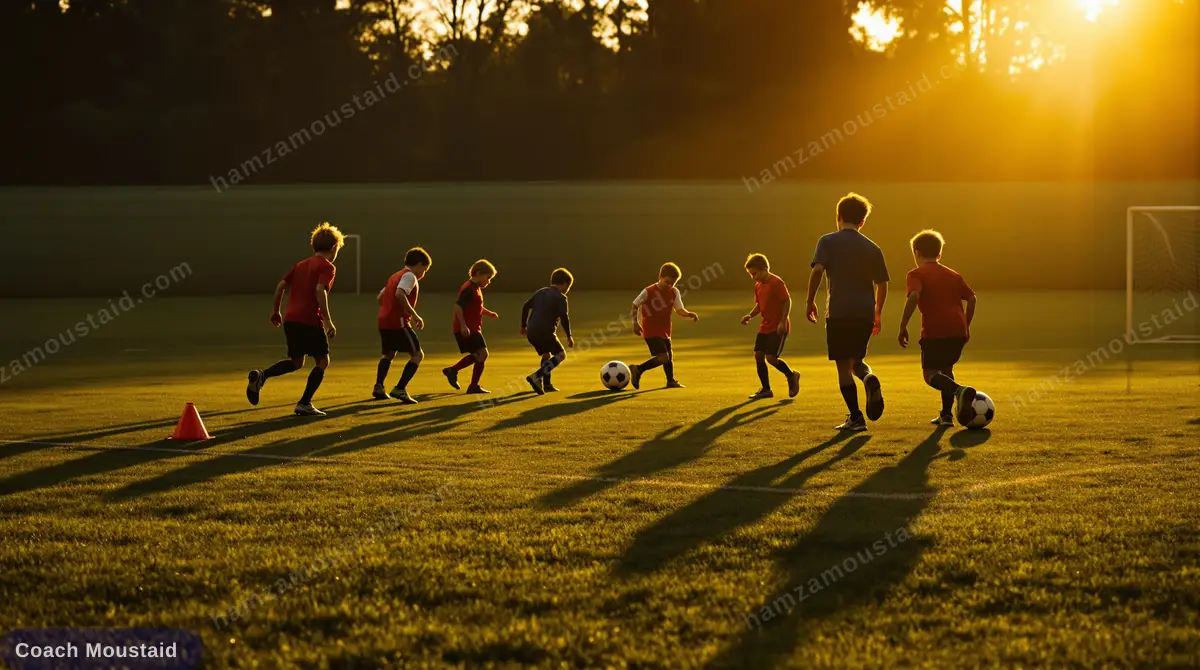
Ten-year-olds are the easiest age group to coach badly. They can follow instructions, so you are tempted to explain. They can do technical work, so you are tempted to line them up. Both instincts kill the session.
At this age the binding constraint is not ability — it is attention. A U11 player will give you roughly 90 seconds of listening before their eyes go to the ball, the other pitch, or their friend. So the session below is built around ball contacts and decisions per minute, not around how clever the drill looks on paper.
What makes soccer drills for 10 year olds actually work?
Four rules I apply to every U11 session, and which I check against afterwards:
- Ball contacts over instruction. Aim for a minimum of 300–400 individual ball contacts per player per session. If a drill has players standing, it is failing.
- Maximum 90 seconds of talking per activity, then play. Demonstrate with the ball rather than describe. If it needs three minutes of explaining, the drill is too complicated for the age.
- Pods of 6 to 8. With 16 players, two grids of 8 beats one grid of 16. With one coach and 20 players, run three self-policing games and rotate yourself between them.
- Change every 8 to 20 minutes. Not because the drill stops working, but because their focus does.
One practical note from working inside a club where pitches are shared: on most evenings the U11 group does not get a full pitch. We frequently work on a 40m × 30m strip along one flank while a senior group has the rest. That constraint turned out to be useful — every activity below fits inside 40m × 30m, and none of it needs full-size goals.
The 75-minute U11 session, block by block
Squad assumed: 14–16 players, two coaches, 16 balls, 20 cones, six small goals or eight poles. Every block below includes the progression.
- Arrival activation — 10 minutes, ball each. No lines, no whistle. Players enter a 25m × 25m square, one ball each, and move freely: inside-foot touches, sole rolls, turns on your shout. Every 60 seconds call a change: "outside foot only", "stop the ball with your sole", "change ball with someone". Late arrivals just join in. This replaces static stretching, which does nothing for a 10-year-old and wastes your best-attention minutes of the evening.
- Rondo 4v1 into 4v2 — 12 minutes. Grids of 8m × 8m, four players on the outside, one defender inside. Two grids side by side. Rule: two touches maximum. Defender wins the ball or forces it out, swaps with whoever lost it. Score the outside team — 6 consecutive passes is a point. After 5 minutes move to 4v2 in a 10m × 10m grid, which forces the outside players to actually open their body and look before receiving.
- 1v1 to two mini-goals — 15 minutes. Channel 12m × 8m, two small goals at each end. Server passes in, attacker attacks, defender defends, both then leave and the next pair starts immediately. Two channels running means the wait is about 15 seconds. Rotate the server every three repetitions. Keep score out loud — U11s invest in a scoreline, they do not invest in "good technique".
- Small-sided game: 3v3 to four goals — 20 minutes. Area 30m × 24m, four small goals (one on each side of both end lines). Three teams of 4–5, two playing, one resting 90 seconds and then replacing the losing team. Four goals is the single best tactical tool at this age: it teaches players to switch play and scan without you saying either word.
- Free game: 7v7 or 5v5 — 15 minutes. Give them the last block with minimal interference. One or two interventions total, each under 20 seconds, and both about a decision you worked on earlier — "where was the free goal?" rather than "pass it".
- Cool-down and exit — 3 minutes. Light jog, ball juggling in pairs, one question each: what did you do well tonight? Collect balls as a race. Done.
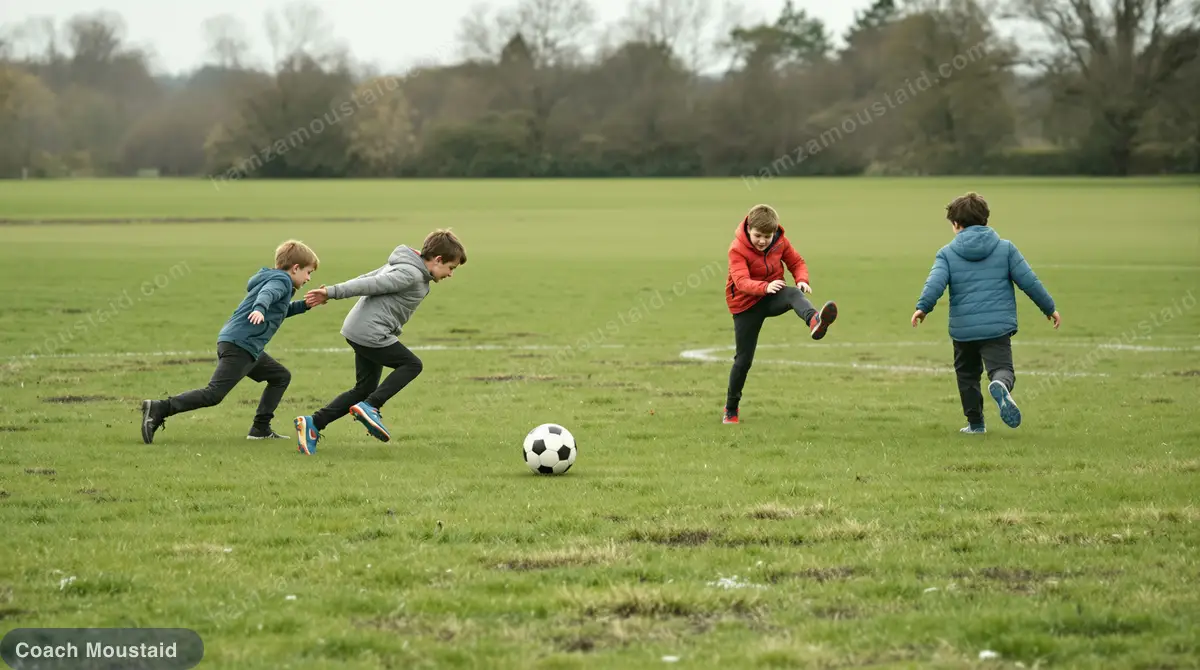
How should the session change between week one and week six?
Coaches lose U11 groups by keeping drills identical. You do not need new drills — you need the same drills with the constraint tightened. This is what the same five blocks look like six weeks apart.
| Block | Week 1 | Week 6 |
|---|---|---|
| Activation | Free dribbling, coach calls changes | Add two defenders as "taggers" who try to kick balls out |
| Rondo | 4v1, 8m × 8m, two touches | 4v2, 10m × 10m, one touch on the outside |
| 1v1 | Attacker starts facing goal, ball rolled in | Attacker receives back to goal and must turn |
| Small-sided game | 3v3, four goals, unlimited touches | 3v3, four goals, three-touch maximum or a two-pass rule before scoring |
| Free game | 5v5, no conditions | 7v7, coach names one team as "the team that must switch play" |
| Coach talking time | Roughly 8–10 minutes total | Under 5 minutes total |
What you should see by week six: players checking their shoulder before the ball arrives in the rondo, and in the 3v3 a first scan towards the far goal instead of straight at the nearest opponent. Those two behaviours are the honest measure of whether the block worked. Goals scored are not.
Which drills should you avoid with 10 year olds?
- Single-file cone dribbling with one ball for twelve players. One player works, eleven wait. It produces perhaps 40 ball contacts in ten minutes.
- Static passing in pairs over long periods. Fine for three minutes as a rhythm setter, dead after that, because there is no opponent and therefore no decision.
- Long laps and unopposed running. Conditioning at this age comes free inside small-sided games. The 3v3 block alone gets heart rates high enough, with the ball.
- Anything requiring a 10-minute set-up. If you cannot build it in 90 seconds with cones, simplify it. Set up the whole session before they arrive: mark all grids with different cone colours in one pass, so block changes take 20 seconds.
- Heavy heading work. Several federations restrict or discourage deliberate heading in youth age groups and the guidance differs by country. Check your own national federation's current youth directive rather than assuming — do not take a figure from an article.

How do you manage behaviour and energy across the session?
The two biggest practical problems with a U11 group are the player who cannot stop talking and the player who disappears when the game gets fast. Neither is a discipline problem.
The talker usually needs a job: server, scorekeeper, or the player who restarts the game. Give it to them in the 1v1 block, where servers rotate constantly, and the problem tends to solve itself. The player who hides usually needs a smaller space — in a 3v3 on 30m × 24m they cannot hide, which is exactly why that block sits before the free game rather than after.
Habits formed at 10 are extremely sticky, in both directions. The way a player reacts to losing a 1v1 in October is normally the way they react in April unless you address it directly — worth reading alongside how negative habits take hold in players and coaches.
Two more things sit under the physical side. First, load: 10-year-olds recover fast but they arrive tired from school, and the quality difference between a Tuesday and a Friday session is real. Second, the basics outside the pitch — sleep, food, hydration, screens — affect a U11 session more than any drill you choose. The four pillars of youth health and the practical side of injury prevention and recovery are worth going through with parents once per season, not once per injury.
How many sessions per week, and what does a month look like?
For a U11 group, two sessions plus one match per week is a realistic and healthy volume. Use the block structure above every time and change only the theme.
- Weeks 1–2: receiving and first touch. Rondo and 1v1 carry the theme.
- Weeks 3–4: 1v1 and dribbling in tight spaces. Add the taggers to activation, keep the four-goal game.
- Weeks 5–6: switching play and scanning. Four-goal 3v3 becomes the main block; extend it to 22 minutes.
- Weeks 7–8: finishing. Same grids, mini-goals replaced by one real goal plus a goalkeeper, 2v2 and 3v2 arrivals.
Repeating the structure while rotating the theme is what gives a U11 group the thing they most need: they know what happens next, so they stop asking, and you get more of their attention for the part that matters. If you want the longer view on how these choices connect to your own ideas about the game, that sits in developing your coaching philosophy.
Frequently asked questions
How long should a soccer session be for 10 year olds?
How many players should be in one drill at this age?
Should 10 year olds do fitness or conditioning work?
How do I keep 10 year olds focused when they get distracted?
Is heading allowed in training for 10 year olds?
What should I actually assess at U11?
Related reading

The 4-3-3 Explained: Roles, Strengths and When It Breaks Down
A coach's breakdown of the 4-3-3 — every role's job, the two midfield variants, the pressing triggers it creates, and the three specific ways it collapses against good opposition.
How to Get a Football Trial: A Practical Guide for Players and Coaches
A step-by-step guide to finding and winning football trials: where trials are advertised, how to contact clubs, what belongs in a football CV, and how to prepare so you perform when the chance arrives.

Football Player Lifestyle Habits: How Bad Routines Quietly Wreck Performance (And How to Change Them)
Sleep, screens, food and recovery routines run on autopilot for most players. Here is how habit loops actually work, why negative habits damage output before anyone notices, and a practical replacement method coaches can run with a squad.