

How to Build an Effective Football Training Session Plan
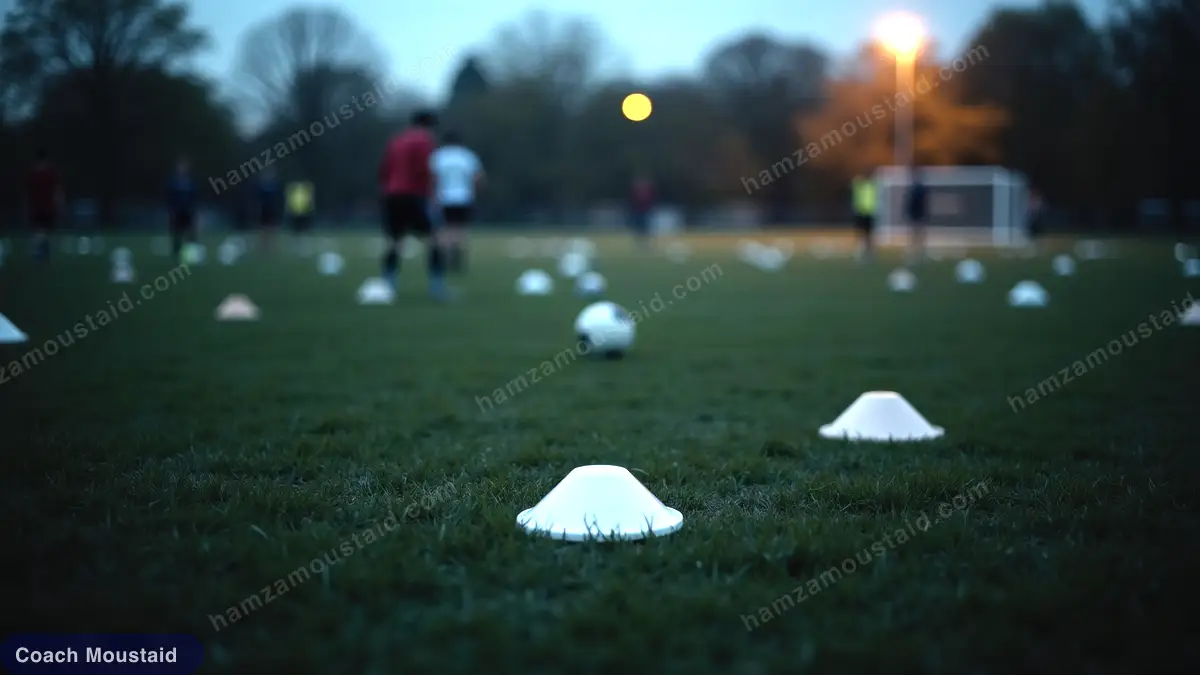
An effective football training session plan follows a game–skill–game structure: open with a small-sided match to diagnose problems, isolate the specific skill or decision that broke down, then return to a game so players apply it under pressure. Explain the purpose of every exercise, then review the session and adjust the next one.
Why the structure of a session matters more than the drills
Most coaches collect drills. Very few build sessions. The difference shows up on matchday: a squad can be excellent at a passing pattern in a static grid and still be unable to play out of pressure at 3–1 down with twenty minutes left. Football is a game of decisions made under time pressure, spatial constraint and opposition, so the training environment has to contain those three things for the learning to transfer.
That is the logic behind the framework below. It is not a rigid template — it is an order of operations. You diagnose, you intervene, you test. The same sequence a physio or a teacher would use. Every part of a football training session plan should be able to answer one question: what problem is this solving?
Step 1: Open with a full game
Start the session with football. Not laps, not a cone circuit — an actual small-sided game, once players have moved enough to be warm. Four v four, five v five, seven v seven depending on numbers and space.
The purpose is diagnostic. You are watching, not correcting. Within ten minutes you will usually see the real issue rather than the one you assumed on the drive to training:
- Players receiving with their back to the pitch and losing possession on first touch
- Nobody offering an option behind the first line of pressure
- Defenders stepping out at the wrong moment
- Finishing rushed because the setup touch is poor, not because the striking is poor
- Attitude and communication issues that no drill will fix
Keep a notebook or a phone note. Write down three observations, not fifteen. A session that fixes one thing well beats a session that touches six things vaguely.
Warming up without wasting the block
You still need a physical preparation phase — activation, mobility, gradual increase in intensity, some ball work. Build it into a rondo, a possession box or a passing pattern so players are getting technical volume while the body comes up to temperature. Time in a session is the scarcest resource you have.
Step 2: Isolate the skill or decision that broke down
Now you intervene. This is the technical or tactical block, and its content is dictated entirely by what you saw in the opening game — passing, first touch, finishing, pressing angles, defending the box, switching play.
Three principles keep this block honest:
- Keep opposition in the exercise wherever possible. Even passive pressure, even one defender, even a time limit. Unopposed reps have a place for very young players learning a movement pattern, but they should be the minority.
- Make the exercise progressive. Start simple, then add a defender, reduce the space, cap the touches, add a scoring condition. Players should feel the difficulty rise as they cope.
- Protect the repetitions. Long queues kill sessions. Use multiple stations, smaller groups, extra balls. Count roughly how many times each player will actually execute the action — if it is under twenty in a fifteen-minute block, redesign it.
Coach in short, targeted interventions. Freeze the practice, show the picture, ask a question, restart. Two or three interventions per block is usually enough; constant stopping drains intensity and attention.
Step 3: Finish with an applied game
Return to a game — ideally the same format you started with, so you and the players can compare directly. This is the test phase, and it is where you find out whether the middle block worked.
Use conditions to bias the game towards the theme without making it artificial:
- Working on playing forward? A goal counts double if it comes within five seconds of winning the ball.
- Working on switching play? A point for every successful crossfield pass into the far channel.
- Working on pressing? Points for regains in the opposition half.
Then remove the conditions for the final few minutes and play free football. If the behaviour survives without the incentive, it has begun to stick. If it disappears immediately, the theme returns next session — that is information, not failure.
Step 4: Tell players why
Players who understand the purpose of an exercise train differently. They self-correct, they hold each other accountable, and they stop treating drills as punishment or filler.
Set the theme in one sentence at the start of the session. Restate it before the middle block. Reference it in the final game. Twenty seconds of clear framing does more than a five-minute tactical speech that nobody retains.
Use questions rather than instructions where you can. "What did you see before you received?" produces more learning than "turn out next time." This is also where your wider identity as a coach shows — the way you explain things comes directly from your coaching philosophy and the playing style you are trying to build.
Step 5: Review the session and adjust the plan
The session is not finished when players leave. Spend ten minutes writing down:
- What was the objective, and was it met?
- Which exercise produced the most learning, and which one dragged?
- Were the numbers, pitch size and duration right?
- Which individual players need something different next time?
- What is the theme for the next session as a result?
Over a season this file becomes the most valuable coaching resource you own — a record of what your specific players respond to. It also protects you from the most common coaching trap: repeating a session because you enjoy delivering it rather than because the team needs it.
A sample session shape
| Block | Approximate share of session | Purpose |
|---|---|---|
| Activation and ball work | Short opening block | Physical readiness, early touches |
| Opening small-sided game | Roughly a quarter | Diagnosis, competitive tone |
| Technical / tactical block | Roughly a third | Isolate and repeat the target action |
| Applied game | Roughly a third | Transfer under pressure |
| Cool-down and debrief | Short closing block | Recovery, reinforce the message |
Adjust the proportions to your context. Under-9s need shorter blocks and more variety. A senior amateur side training twice a week needs more competitive volume and less isolated technique. A team playing Saturday and Wednesday needs load management to dominate the plan. Session duration, pitch dimensions and permitted contact for youth age groups are set by your national federation or league — always check your own competition's rules rather than copying figures from another country.
Common mistakes that ruin otherwise good plans
- Planning for the drills you like. The plan should follow the last match and the last session, not your favourites folder.
- Too many themes. One clear objective per session. Two at most.
- Over-talking. Count your speaking time. It is almost always longer than you think.
- No progression or regression ready. If an exercise is too easy or collapsing, you need the adjustment in your head before it happens.
- Ignoring the emotional temperature. Players arrive tired, stressed or distracted. Managing that is part of the job, and controlling your own reactions is the first step.
- No plan B for numbers or weather. Write your session for the players who might actually turn up.
Building the habit
Write the plan down every time, even for a thirty-minute session with eight players. A single page: objective, blocks, timings, pitch sizes, coaching points, progressions. The act of writing it exposes gaps that never appear when the session lives only in your head.
Then keep developing the underlying knowledge. Structured courses give you the vocabulary and the assessment framework — you can start with free online coaching certificates and work towards a formal badge such as the federation licence pathway in Morocco. What separates coaches over ten years is rarely the drills they know. It is the discipline of planning, observing and reviewing, week after week, and the habits that make a coach effective long before any tactical detail.
Frequently asked questions
How long should a football training session be?
Should I always start a session with a game?
How many objectives should one session have?
What if I don't have enough players for small-sided games?
How do I know whether the session worked?
Do I need a coaching licence to plan sessions properly?
Related reading
How to Become a Football Coach: A Practical Route Into Coaching
A step-by-step guide to becoming a football coach: finding your national FA's entry-level licence, tracking down course announcements, and building real experience while you wait for a place.
Football Playing Styles: How to Build One Your Team Can Actually Deliver
Tiki-taka, direct play, high press or low block — there is no single correct football playing style. Here is a practical framework for choosing one, adapting it to your squad, and coaching it into your players week by week.

Free Online Football Coaching Courses: Start With The England Football Playmaker Certificate
A practical guide to free online football coaching courses — starting with England Football's Playmaker certificate — and how to use them before you enrol in a paid federation licence.