

The Qualities of a Good Football Coach: 7 Traits That Actually Decide Your Success
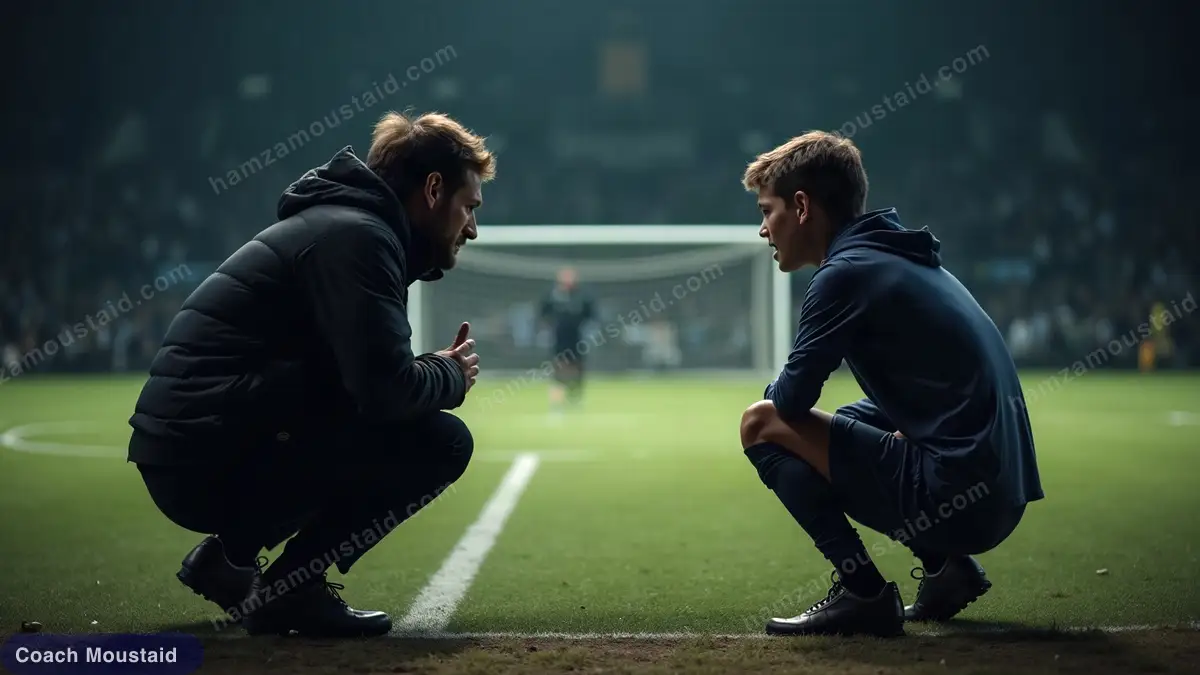
The qualities of a good football coach are personal before they are tactical: self-confidence, clear communication, the ability to motivate, personal discipline, continuous learning, positive thinking and flexibility with different players. Tactics can be taught quickly. Character is what makes players trust you, follow you and improve under you week after week.
Most coaches spend their first years chasing knowledge — formations, pressing schemes, periodisation models. That knowledge matters, but it is not the bottleneck. Sit in on two sessions run from the same session plan, delivered by two coaches, and the difference in player engagement will be enormous. The plan was identical. The person delivering it was not.
What follows is a breakdown of the seven traits that consistently separate coaches players want to play for from coaches players merely tolerate — and, more usefully, how to build each one on purpose rather than hoping it arrives with experience.
1. Self-confidence: you are the reference point
A coach is a model for the players and for everyone around the team — parents, staff, club officials. That is true whether you want it to be or not. Players read your body language on the touchline before they hear your instructions. If you hesitate over a substitution, they see hesitation. If you contradict yourself at half-time, they stop believing the first version.
Self-confidence in coaching is not volume and it is not arrogance. It is the willingness to make a decision, own it publicly, and evaluate it honestly afterwards. Practically:
- Decide before you need to. Know in advance what you will do if you are 1-0 down with twenty minutes left, or if your key midfielder picks up a card. Pre-made decisions look like confidence because they arrive without visible panic.
- Prepare so thoroughly that you are not bluffing. Genuine confidence is a by-product of preparation. Coaches who write their sessions properly walk onto the pitch differently.
- Say "I got that wrong" when you did. Admitting an error costs you nothing with players and buys enormous credit. Denying an obvious error costs you everything.
Confidence is also easier to sustain when your identity as a coach is clear. If you have not yet written down what you believe about the game, start there — a defined coaching philosophy gives you something stable to make decisions from when a result goes against you.
2. Communication: simple, direct, and two-way
The most common coaching failure is not bad ideas. It is good ideas explained badly. If a player cannot repeat your instruction in one sentence, they have not received it.
How to explain better
- One coaching point per intervention. Not three. Players can hold one idea into the next repetition.
- Show, then say. A ten-second demonstration replaces ninety seconds of talking, and it works across language barriers and age groups.
- Use the players' vocabulary. "Half-space" means nothing to a twelve-year-old. "Between their full-back and centre-back" does.
- Check understanding by asking, not telling. "Where do you go when the ball goes back to the goalkeeper?" tells you instantly whether the message landed.
The half nobody practises
Listening is the part of communication coaches neglect. Players know things you do not: how their hamstring actually feels, why two teammates are not passing to each other, what is happening at school or at home. Build deliberate space for it — a two-minute conversation with two different players after every session, rotating through the squad, will tell you more over a season than any questionnaire.
3. The ability to motivate — especially when things go badly
Players need your support most in the weeks when supporting them is least enjoyable: after a heavy defeat, during an injury, after a mistake that cost a goal. Motivation delivered only in good times is not motivation, it is celebration.
Effective motivation is specific and honest. "Well done, lads" is noise. "Your first press after the goal kick was better than last week — you got three turnovers from it" is information the player can act on. Praise the behaviour you want repeated, and be precise about it.
A few principles that hold up across levels:
- Correct the action, never the person. "That decision was late" not "you're always late".
- Give private feedback for anything a player might feel embarrassed by, and public feedback for anything you want the group to copy.
- Set targets a player controls. Winning is not controllable; making six forward passes in the first half is.
- Remember that unequal treatment is often necessary. Some players respond to challenge, others shut down under it. Knowing which is which is the job.
4. Discipline: the standard is whatever you tolerate
You cannot demand punctuality while arriving late. You cannot demand focus while checking your phone during the warm-up. Players calibrate their standards to yours within about three sessions, and once the standard has slipped it takes months to recover.
Set a small number of non-negotiables and enforce them without exception:
| Standard | What it looks like from the coach |
|---|---|
| Punctuality | Pitch set up and cones out before the first player arrives |
| Preparation | A written session plan every single time, including friendlies |
| Respect | No public criticism of referees, opponents or your own players |
| Effort | Full engagement in every drill, including the boring ones |
| Appearance | Turning up dressed like the job matters |
Discipline also extends to how you look after yourself. Coaching is emotionally and physically demanding, and a tired coach makes worse decisions on the touchline — which is why maintaining your own physical and mental condition belongs in the same conversation as team discipline.
5. Continuous learning: the game moves faster than your licence
Football changes constantly. Pressing structures, set-piece routines, load management, the way information is delivered to players — all of it looks different from a decade ago. A coach who stopped learning after their last badge is coaching a version of the game that no longer exists.
Build a learning routine rather than relying on courses alone:
- Formal qualifications. Work through your national federation's pathway. Requirements, entry criteria and costs differ by country and change over time, so verify the current details directly with your federation before planning around them. If you are working in Morocco, the process for obtaining a coaching licence is a good place to start.
- Free structured courses. There are legitimate free options online, including some certificated coaching courses, which are useful for filling gaps between badges.
- Watch other coaches work. Observing a live session — any level, any age group — teaches you more about delivery than any video.
- Review your own sessions. Film ten minutes on a phone. Count how long you talk versus how long the ball is rolling. Most coaches are shocked the first time.
- Read outside football. Learning, motivation and habit formation are studied seriously in other fields, and that work transfers.
Learning should also feed directly into how you train. If your ideas are not changing what happens on the grass, they are decoration — start by tightening up how you structure an effective training session.
6. Positive thinking: solutions over blame
Defeats are guaranteed. What is not guaranteed is how the group responds to them, and that is determined almost entirely by the coach's reaction in the first ten minutes after the whistle.
Positive thinking here does not mean pretending a 4-0 loss was fine. It means refusing to spend energy on blame and directing all of it towards causes and fixes. A simple discipline: after every match, identify two things the team did well and one clear problem to work on this week. Two-to-one, always. Players who only ever hear what went wrong stop taking risks, and a team that stops taking risks stops improving.
This is also where emotional control becomes a technical skill rather than a personality trait. Touchline outbursts cost you information, credibility and sometimes players — controlling your reactions as a coach is trainable, and worth training.
7. Flexibility: different players, different levers
A good coach knows how to work with players of different ages, backgrounds and personalities. The same message delivered identically to a fifteen-year-old academy prospect and a thirty-two-year-old amateur with a full-time job will succeed with one and fail with the other.
- Children (up to ~12): short instructions, plenty of ball contact, games rather than lectures, enjoyment as the primary outcome.
- Adolescents (13-17): explain the why behind everything, involve them in decisions, expect emotional volatility and do not take it personally.
- Adults: respect their time, be efficient, treat them as partners in the process rather than pupils.
Flexibility applies to tactics too. Coaches who insist on one system regardless of the players available are prioritising their own comfort over the team's results — which is why it is worth understanding how to develop and adapt playing styles rather than defending a single model.
How to actually develop these qualities
Reading a list changes nothing. Working on one item at a time does. A practical approach:
- Score yourself honestly out of ten on each of the seven qualities.
- Pick the lowest score. Just one.
- Choose a single concrete behaviour that improves it — for example, "one coaching point per intervention" for communication.
- Apply it in every session for four weeks and note what changes in player response.
- Ask a trusted colleague or an experienced player whether they noticed a difference. Their answer is more reliable than yours.
- Re-score, then move to the next quality.
None of this depends on having played professionally. The best communicators and motivators I have worked alongside in the Moroccan system came from wildly different playing backgrounds, and several had none worth mentioning — you genuinely do not need a playing career to become a successful coach. What you need is the willingness to be the most prepared, most consistent and most honest person on the training ground, week after week.
Start with one quality. Four weeks from now, your players will notice before you do.
Frequently asked questions
What is the single most important quality of a good football coach?
Can these qualities be learned, or are they personality traits?
Do I need a coaching licence to be a good coach?
How should I react immediately after a heavy defeat?
How do I know whether I am actually improving as a coach?
How do I adapt my coaching to different age groups?
Related reading

How to Become a Football Coach Without Playing Professionally
A practical route into coaching for people who never played at a high level: licences, volunteering, match analysis, and the habits that turn study into real credibility.

Mental Preparation in Football: How Coaches Stay Sharp in Mind and Body
Mental preparation in football begins with the coach. Five practical habits — plus a weekly system — to keep your mind and body in the condition your team needs.

Soccer Drills for 10 Year Olds: A 75-Minute Session That Holds Their Attention
A full 75-minute session for U11 players — five blocks, exact durations, grid sizes and squad numbers, plus how each drill should look in week one versus week six.