

Football Playing Styles: How to Build One Your Team Can Actually Deliver
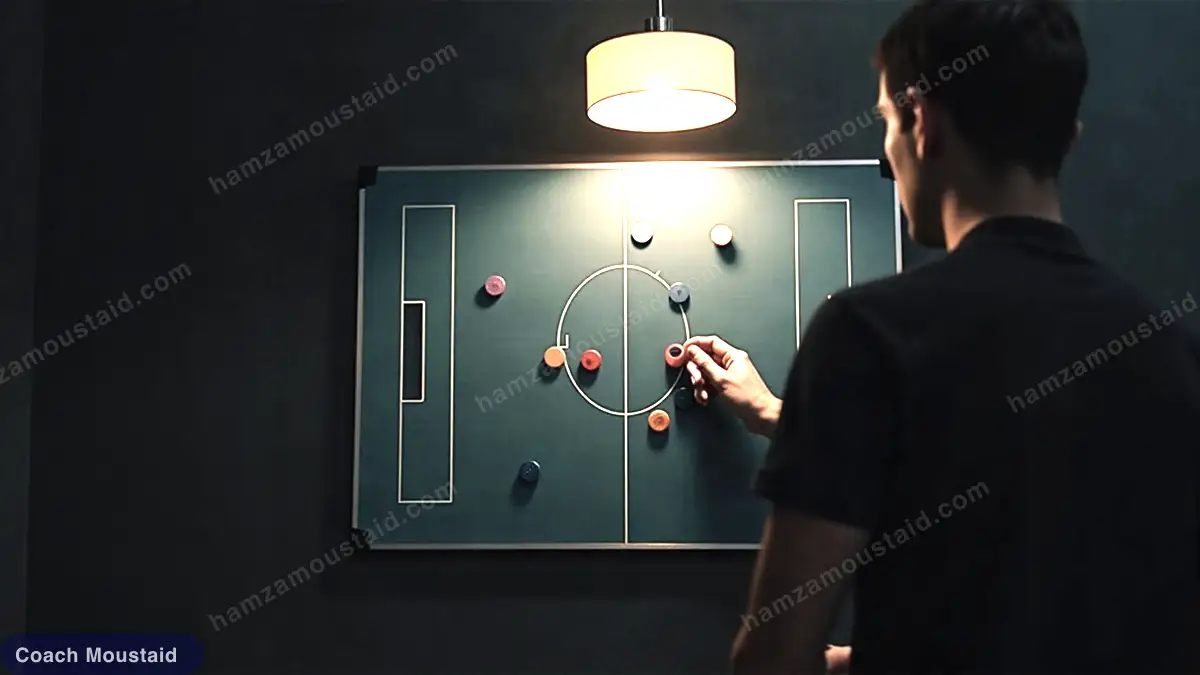
A football playing style is your team's identity on the pitch — how you attack, how you defend, and how you behave in the seconds of transition between the two. Building one means choosing a clear approach, matching it to the players you actually have, communicating it consistently, and rehearsing it in realistic training.
What a playing style actually is
Ask ten coaches to define a playing style and you will get ten answers. The most useful working definition is the simplest one: a playing style is the way your team plays football across the four moments of the game.
- In possession — how you build from the back, how you progress the ball, how you create and finish chances.
- Out of possession — where you defend, how high you press, whether you screen passing lanes or hunt the ball.
- Transition to attack — what happens in the first three to five seconds after you win the ball.
- Transition to defence — what happens in the first three to five seconds after you lose it.
Note what is missing from that list: formation. A formation is a starting arrangement of bodies. A playing style is a set of behaviours and decisions. Two teams can both line up 4-3-3 and play completely different football. Coaches who begin with the shape rather than the behaviour usually end up with a team that looks organised in the team talk and looks confused in the 63rd minute.
Why it matters more than most coaches think
Without a clear playing style, your players walk onto the pitch without a shared plan. Everyone has an idea of what to do — but they are different ideas. The full-back wants to overlap, the winger wants the ball to feet, the midfielder wants to switch play. Nobody is wrong individually and the team is incoherent collectively.
A defined style solves three problems at once:
- Decision-making speed. Players do not have time to weigh five options. A style narrows the menu, so the choice becomes quicker and more consistent.
- Recruitment and selection. When you know how you want to play, you know what kind of player you are looking for and which players fit which role.
- Training design. Every session has a purpose because every session is a rehearsal of the style. That alone transforms how you plan an effective training session.
The main football playing styles
There is no single correct approach — that is the interesting part. Below are the styles you will meet most often, with the demands each one places on a squad. Most successful teams blend two or three rather than sticking rigidly to one.
| Style | Core idea | What it demands |
|---|---|---|
| Positional possession (tiki-taka) | Control the game through short passing, occupation of space and patient circulation | Technically secure players under pressure, high football IQ, disciplined spacing, a goalkeeper comfortable with the ball |
| Direct play | Move the ball forward quickly into the final third, compete for second balls | A target forward or fast runners, strong midfield duels, organised support around the first contact |
| Counter-attacking | Concede territory, defend compactly, attack space at speed on the turnover | Pace in wide areas and up front, defensive discipline, calm decision-making in the final pass |
| High press | Win the ball high up the pitch and score close to goal | Very high fitness levels, coordinated pressing triggers, a high defensive line and a sweeping goalkeeper |
| Mid or low block | Deny central space, force play wide, defend the box | Concentration, communication, patience, well-drilled defensive shape |
| Wide overload / crossing | Create and attack from wide areas with numbers in the box | Quality crossers, aerial threat, full-backs with running capacity |
Six steps to develop your own playing style
1. Start with what you genuinely believe
Think honestly about how you like football to be played. If you do not believe in what you are asking for, players will hear it in your voice within a fortnight. Your style should sit inside a wider set of principles — this is where your coaching philosophy comes in. Philosophy is the why; style is the how.
2. Audit the players you actually have
This is the step most coaches skip. Before you commit, write down your squad's honest profile: pace, technical security under pressure, physical capacity, game understanding, age, and how many sessions a week you get with them. A high press with two sessions a week and a squad that cannot sustain repeated sprints is not a style — it is a wish.
Ask three questions of every idea:
- Can my players execute this today, at maybe 60% quality?
- Can they reach 80% within a season with the training time I have?
- Does it use our biggest strength rather than exposing our biggest weakness?
3. Define it in principles, not paragraphs
Reduce your style to a small number of clear principles per moment — three or four is plenty. For example, in possession: build through the middle third, create a spare player behind the first line, attack the space behind the last defender when it appears. Out of possession: press on the backwards pass, keep the ball on one side, protect the central corridor.
If a principle cannot be observed on video, it is not a principle — it is a slogan.
4. Communicate consistently
Use the same words every week. If "press" means one thing on Tuesday and something else on Saturday, players stop listening. Keep the language short, concrete and age-appropriate: younger players need pictures and demonstrations, senior players can handle tactical vocabulary. Consistency here is one of the habits that separate effective coaches from ones players find hard to follow.
5. Train it with repetition, relevance and realism
Players learn a style by living it, not by hearing it. Three tests for every practice:
- Repetition — does the key behaviour occur many times, not twice?
- Relevance — does it look like the part of the game you are trying to improve, with real directions, goals and opponents?
- Realism — is there genuine pressure, an opponent, a scoreline, a time limit?
Unopposed passing patterns have a place early in the week, but a style is only proven under resistance. Constraints work well: limit touches to force quicker circulation, award bonus points for regaining the ball within six seconds, restrict the build-up zone to force play through a particular channel.
6. Rehearse match scenarios
Games are not played in a steady state. Build scenarios into training: 1-0 up with ten minutes left, playing against ten men, chasing a goal, defending a deep block, restarting after conceding. This teaches players to adapt within your style instead of abandoning it the first time the match turns against them. A team with one rigid plan is easy to beat twice.
Common mistakes
- Copying an elite team wholesale. What works with full-time professionals and daily video analysis rarely transfers to two sessions a week.
- Changing after every defeat. Judge the style over a block of matches, not one result. Look at whether the behaviours appeared, not only the scoreline.
- Confusing style with formation. You can change shape and keep your identity.
- Overloading the players. Four clear principles delivered well beats twenty delivered vaguely.
- Letting emotion overwrite the plan. Touchline panic undoes months of work — managing your own reactions is part of protecting the style.
How to measure whether it is working
Set observable markers before the season and review them monthly. Depending on your style these might be: number of build-up sequences completed past the opposition's first line, time taken to regain possession, share of entries into the final third through central areas, or number of shots conceded from inside the box. You will not have professional data tools — a coach with a notepad counting a single behaviour across 90 minutes is enough to start.
Also review the human side: are players making faster decisions? Are they correcting each other on the pitch without waiting for you? That is the clearest sign a style has been internalised rather than memorised.
Keep developing as a coach
Your ability to teach a style grows with your own study. Watch full matches rather than highlights, analyse your own games on video, and keep adding to your formal education — the pathway for coaches in Morocco is set out in our guide to getting a coaching licence, and there are also free online coaching certificates worth working through. Always confirm current fees, entry requirements and course dates directly with the relevant federation or provider, as these change.
Above all, have a preferred way of playing. It gives your team a plan, gives your players a reference point when the game gets chaotic, and gives your training a reason to exist.
Adapted and expanded from guidance published by The Football Association.
Frequently asked questions
What is the difference between a playing style and a formation?
Should I choose a playing style before or after seeing my squad?
How long does it take for a team to learn a new playing style?
Can I use more than one playing style?
How do I coach a playing style with only two sessions a week?
How do I know my playing style is working?
Related reading

How to Become a Football Coach: A Practical Route Into Coaching
A step-by-step guide to becoming a football coach: finding your national FA's entry-level licence, tracking down course announcements, and building real experience while you wait for a place.

Free Online Football Coaching Courses: Start With The England Football Playmaker Certificate
A practical guide to free online football coaching courses — starting with England Football's Playmaker certificate — and how to use them before you enrol in a paid federation licence.

How to Build an Effective Football Training Session Plan
A practical, step-by-step framework for building a football training session plan that actually transfers to matchday — using a game–skill–game structure, clear objectives and honest post-session review.